info@Web-SEO1.com
 Support

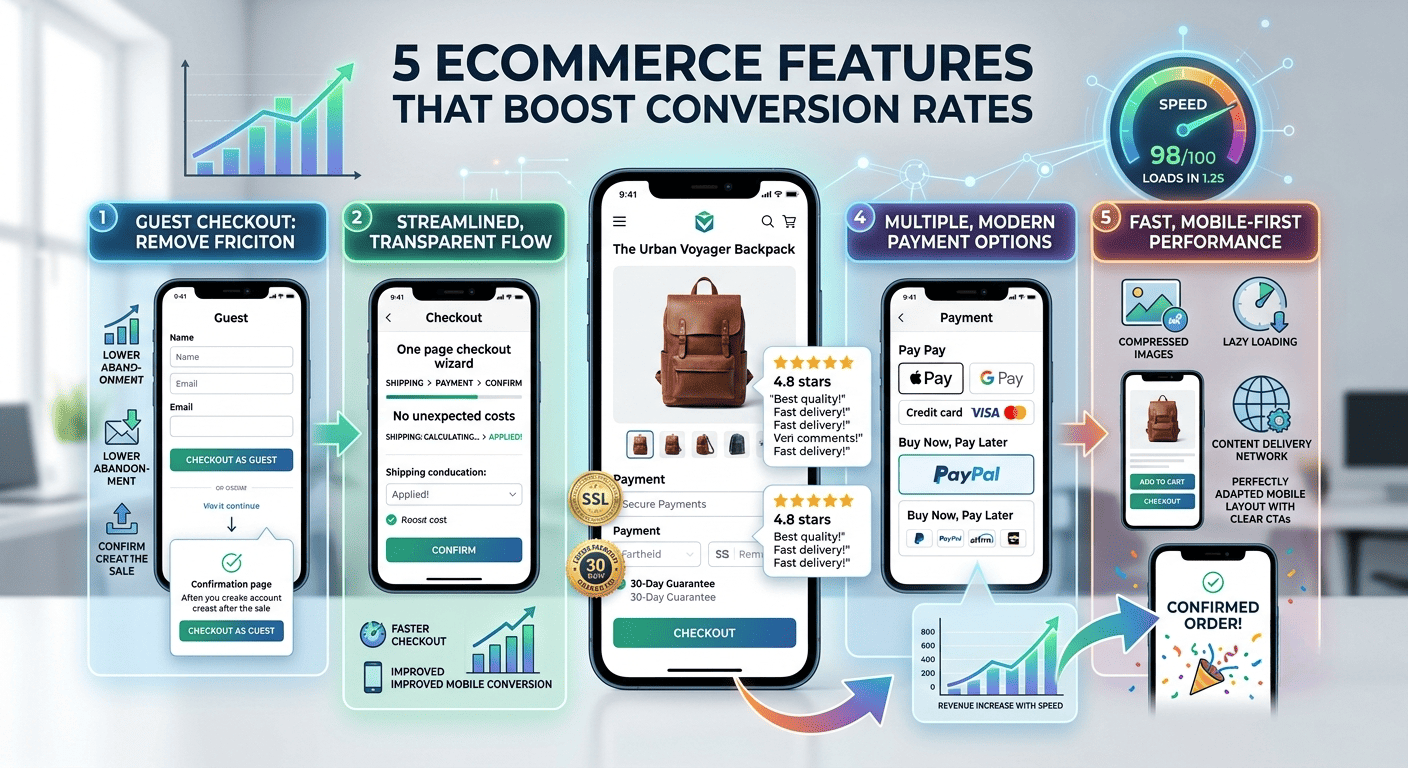
5 eCommerce Website Features That Boost Conversion Rates
Most online stores don’t have a traffic problem. They have a conversion problem. Getting a visitor to your product page is only half the battle — turning that visitor into a paying customer is where most eCommerce revenue quietly disappears. Roughly seven out of every ten shoppers who reach checkout leave without completing their purchase, and the good news is that most of that abandonment traces back to a handful of fixable features, not a fundamental flaw in your product or pricing. Here are five eCommerce website features that consistently move the needle on conversion rate and why each one matters more than it might seem.
1. Guest Checkout
Forcing a first-time visitor to create a password-protected account before they can buy something is one of the most well-documented conversion killers in eCommerce, and it’s still one of the most common mistakes online stores make. Roughly a quarter of shoppers abandon their purchase entirely when checkout requires forced account registration, and separate research puts that number even higher for stores that make account creation the very first step at checkout.
The fix isn’t to eliminate accounts altogether — customer accounts are genuinely useful for order history, loyalty programs, and repeat purchases. The fix is timing. Let customers check out as a guest using only the information you’d need anyway (name, email, shipping address), then invite them to save that information and create an account on the confirmation page after the sale is complete. At that point, the ask feels like a convenience rather than a barrier, and you capture the account-creation benefit without risking the sale to get it.
2. A Streamlined, Transparent Checkout Flow
Once a shopper is willing to buy, every additional field, click, or surprise between “add to cart” and “order confirmed” is a chance for them to reconsider. Two things matter most here: fewer steps and no surprises.
Consolidating checkout onto a single scrollable page rather than a multi-step wizard removes the anxiety of not knowing how many steps remain, and stores that switch to one-page checkout typically see meaningful drops in abandonment, particularly on mobile, where jumping between separate screens is its own source of friction. Just as important: show shipping costs, taxes, and any fees as early as possible, ideally on the product page rather than revealing them for the first time at checkout. Unexpected costs at checkout are consistently cited as the single biggest reason shoppers abandon a cart, ahead of price sensitivity or even account requirements.
3. Visible Trust Signals and Real Customer Reviews
Online shoppers can’t pick up your product, and they can’t read your body language the way they could with an in-person purchase. Trust signals do that work for you. Security badges, SSL indicators, and clear return policies placed near your payment form measurably reduce the hesitation shoppers feel right before entering their card details — stores that display trust signals in line with payment fields see notably higher payment completion rates than those that bury this information in a footer link.
Reviews do similar work earlier in the journey. A product page with specific, recent customer reviews gives a hesitant shopper the social proof they’re looking for before they ever reach checkout, and it differentiates a page that otherwise looks identical to a dozen competitors selling the same item. Specificity matters more than volume: a handful of detailed, recent reviews that mention real use cases tend to convert better than a large but stale review count that hasn’t been updated in years.
4. Multiple, Modern Payment Options
Not every shopper wants to type in a 16-digit card number, and increasingly, many don’t expect to have to. Offering digital wallets like Apple Pay and Google Pay alongside traditional cards and a buy-now-pay-later option removes friction for shoppers who have a strong preference for how they pay — and that preference is more common than many store owners assume. Payment diversity has a measurable lift on conversion, largely because express payment options auto-fill address and card details, cutting out the most tedious part of the checkout flow entirely. For higher-priced items, offering a pay-over-time option can also lift average order value, since it changes how a shopper mentally frames the cost of a purchase.
5. Fast, Mobile-First Performance
None of the features above matter if a shopper never makes it past your homepage or product page because the site is too slow to hold their attention. Mobile now drives most of the retail traffic for most eCommerce categories, which means mobile performance isn’t a secondary concern — it’s the primary one. A page that loads even a fraction of a second faster measurably improves conversion, while a product page that takes several seconds to load on a phone will lose a meaningful share of visitors before they’ve even seen what you’re selling.This is where a proper website design pays for itself: compressed images, lazy loading, a content delivery network, and a mobile layout designed thumb-first rather than shrunk down from a desktop layout.
Building These in from the Start
The common thread across all five features is that it’s far easier — and far cheaper — to build these features in from the beginning than to retrofit them into an existing store later. A checkout flow never designed for guest access, a theme not built mobile-first, or a payment gateway that supports only one payment type all become expensive, disruptive fixes once a store is live and generating revenue.
If your online store is missing one or more of these features, or you’re not sure where your biggest conversion leak is, an outside audit is the fastest way to find out. Power Marketing International builds and optimizes eCommerce websites with conversion, speed, and mobile usability built in from day one. Request a quote to see what a stronger-converting store could look like for your business.